
Venture Debt (Part 1)
The False Binary Shaping Most Funding Decisions
VENTURE DEBT
Capital should match the problem it is solving
This is where many funding decisions go wrong.
Instead of asking “what problem needs to be solved”, founders jump straight to “how much equity should I raise?” But capital is a tool, and different tools exist for different jobs.
Some businesses need capital to fund aggressive, uncertain expansion. Some to develop entirely new products or enter new markets. Others simply to fund a defined path to breakeven.
These situations are not the same — yet they are often treated as though they are.
If a business does not require the flexibility, governance, and upside-sharing that comes with equity, then equity may be solving the wrong problem.
Where venture debt fits — conceptually
This is where venture debt enters the conversation.
Venture debt is not a replacement for equity. It is not inherently better or worse. It is a timing tool. Its primary function is to buy time without immediate dilution.
That time might be used to:
Reach cashflow breakeven.
Scale recurring revenues.
Develop additional functionality.
Equity providers tend to view these moments as valuation milestones rather than incremental progress.
Moving from £100k monthly cash burn to breakeven typically delivers a greater step-change in valuation than reducing burn from £200k to £100k. The market does not reward symmetry. Breakeven is a threshold, not just another data point.
Using venture debt to achieve these milestones can delay an equity raise until valuation improves – or avoid an equity raise altogether.
For businesses with a credible route to breakeven, this distinction matters. Capital that buys time without permanently giving away ownership deserves consideration — yet it is rarely part of the initial framing.
This is not because venture debt is obscure. It is because the funding conversation has narrowed before it even begins.
Why this matters
The mistake I see most often is founders not even considering venture debt as a capital-raising option.
Founders are encouraged to be pro-equity – focusing on the tool – rather than pro-capital, which is the desired outcome.
When the only perceived option is equity, businesses often:
Raise earlier than necessary.
Give up more ownership than required.
Optimise for valuation rather than sustainability.
Fundamentally, raising capital via debt rather than equity is often a more cost-effective option. VC interest itself is a useful signal here – equity investors typically underwrite to 2.5x-3.5x fund-level returns and much higher outcomes on individual deals. Their interest is an indication they perceive strong upside – this comes at the cost of existing shareholders.
What comes next
In this first article, my aim is not to argue for venture debt, but to challenge the assumption that equity is the only option available to growth businesses.
In the next article, I’ll explore why venture debt exists at all — despite loss-making businesses, negative cashflow, and no tangible security — and why only a small number of lenders are willing (or able) to provide it.
Understanding that is key to understanding when venture debt works — and when it does not.
About the author
I advise businesses and their management teams on complex funding situations involving structured finance and venture debt.
The focus is on helping businesses match the right type of capital to the stage, structure, and realities of the business.
I’ll be exploring these themes further in this series.
Leon Musmann - Structured Finance & Venture Debt Advisor
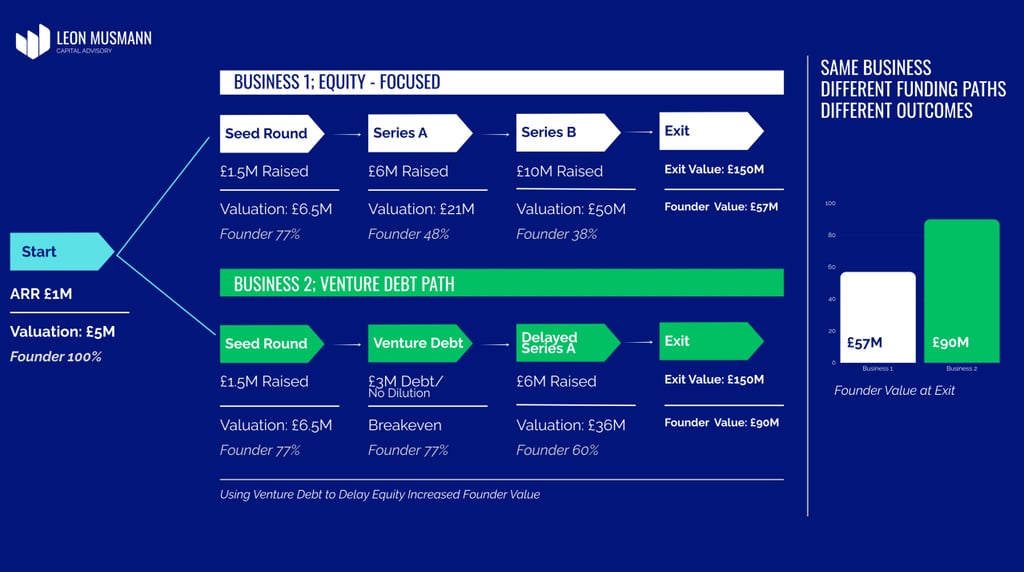
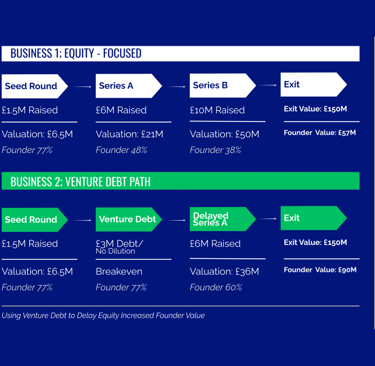
Most founders I speak to don’t make a funding choice; they follow a predetermined path:
Pre-Seed.
Seed.
Series A.
Series B.
Equity is assumed – the only variable is valuation.
I often speak with founders delivering £1m+ of annual recurring revenues (ARR), strong customer retention, and good IP. They typically already have VCs investors or are attracting VC interest.
Their conclusion seems obvious – “we need to raise equity from these VCs”.
That conclusion is wrong.
Not because equity is bad, but because the decision is framed as binary – raise equity now, or run out of money later. Founders rarely pause to ask a more basic question:
Is equity the right tool for what this business needs next?
Why founders default to equity
Equity dominates founder thinking for understandable reasons.
It is the most visible form of capital. It features in headlines, podcasts, and pitch decks. It is flexible, forgiving, and does not require repayment on a fixed timetable. For very early-stage businesses, it is often the only viable solution.
But there is a side effect. Equity becomes framed as the only available option.
Funding discussions begin with “when we raise” rather than “what kind of capital fits this phase”. Advisors, investors, and founders alike default to equity because it is familiar and because it delays difficult questions about repayment, discipline, and downside scenarios.
Remember – Equity is a tool. Capital is the objective.
Dilution is not bad – but it is expensive
Dilution is often discussed as something founders should avoid. In reality, dilution is neither good nor bad. It is a trade-off.
Each equity raise is based on an assumption – growth enabled by the new capital creates enough incremental value (“jam tomorrow”) to justify the part of the business given away. If true, dilution was cheap. If false, it was very expensive.
What matters is timing.
All things being equal, pushing an equity raise further into the future almost always improves the economics for existing shareholders. Higher revenues, reduced risk, and clearer unit economics support higher valuations.
The same amount of capital raised later costs less ownership – or delivers more capital for the same dilution.
This is common sense. Yet many businesses raise equity earlier than they need to because alternatives are not considered or even known.
OFFICE
Empire Capital
25 North Row,
Mayfair,
London,
W1K 7DJ


Capital advisory services provided by Leon Musmann as an appointed adviser of Empire Capital Solutions (London) Limited.
Empire Capital Solutions acts as principal for all client engagements.
This website does not constitute a financial promotion or offer of regulated advice.